
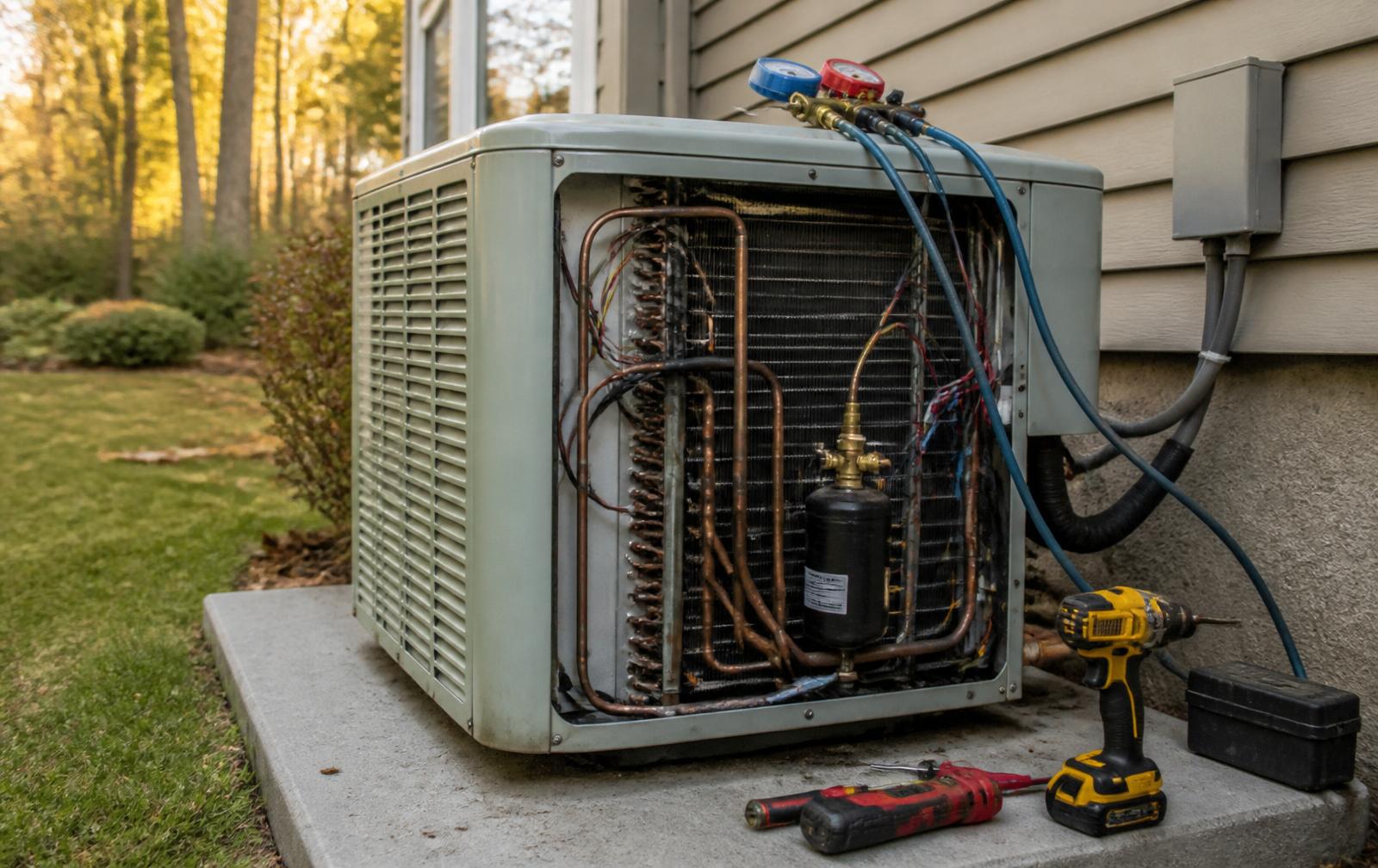
If you live in Powder Springs, you already know what a July afternoon feels like: mid-90s air temperature, humidity that won't quit, and an AC system that runs almost non-stop from May through September. That workload is exactly why so many Powder Springs homeowners end up searching for AC repair before they're ready for it. The good news — most of the calls we run in this ZIP code are for the same handful of problems, and most of them are fixable in a single visit.
This guide walks through the AC failures we see most often in Powder Springs homes, what usually causes them, and what you can safely check before you pick up the phone. It's written for the neighbor calling us on a Saturday evening — not for a technician.
Why AC systems fail more often in Powder Springs
Most residential AC systems in Powder Springs are sized to handle roughly 90–95°F design temperatures. During a heat wave, real outdoor temps push past that, humidity spikes, and the equipment simply runs longer to keep up. Longer runtime means more heat inside the condenser, more current draw on the compressor and capacitor, and more stress on every moving part. Add red Georgia clay dust that cakes onto outdoor coils, plus tree pollen that clogs filters faster than owners expect, and you've got the perfect setup for a mid-July breakdown.
The 5 most common AC repairs we run in Powder Springs
1. Failed run capacitor
This is easily the number one summer call. The run capacitor is a small cylindrical component in your outdoor unit that gives the compressor and fan motor the jolt they need to start. Heat kills capacitors. When one fails, the outdoor fan may hum but not spin, or the whole unit may click and shut off. Replacement is quick and inexpensive — usually the least expensive repair on the list — but the diagnosis has to be right, because a weak capacitor also puts extra strain on the compressor itself.
2. Refrigerant leak (low charge)
If your AC is running but your house won't cool below the mid-70s, and you notice ice forming on the copper line at the outdoor unit, you likely have a refrigerant leak. Refrigerant doesn't get 'used up' — if it's low, it's leaking somewhere. Simply topping it off without finding the leak is a waste of your money. A proper repair means locating the leak (usually at a coil or fitting), fixing it, pulling a vacuum, and recharging to the manufacturer's spec.
3. Frozen evaporator coil
A frozen indoor coil looks dramatic — ice on the copper lines, water pooling under the air handler — but the root cause is almost always airflow. A clogged filter, closed supply registers, or a dirty blower wheel starves the coil of warm return air, the refrigerant gets too cold, and moisture in the air freezes on contact. Shut the system off, let it thaw fully, replace the filter, and call for service. Running it while frozen can burn out a compressor.
4. Contactor failure
The contactor is a heavy-duty electrical switch in the outdoor unit. Ants, pollen, and pitting from repeated arcing eventually stop it from closing cleanly. Symptoms: the thermostat calls for cool, but the outdoor unit does nothing — no hum, no click. This is a routine replacement and a great example of why annual maintenance catches problems before they leave you without cooling on a Saturday night.
5. Clogged condensate drain
Cobb County humidity means your AC pulls gallons of water out of the air every day. That water drains through a small PVC line that clogs with algae. Most modern systems have a safety switch that shuts the AC off before that water floods your ceiling or attic. If your AC just 'won't turn on' but the thermostat still has power, a clogged drain line is one of the first things to check.
What you can safely check before calling
- Thermostat: set to COOL, fan on AUTO, and 4–5° below current room temp.
- Filter: pull it out. If light won't pass through it, replace it and give the system 20 minutes.
- Breakers: check the panel for a tripped 'AC' or 'Air Handler' breaker. Reset once. If it trips again, stop and call.
- Outdoor unit: clear leaves, grass clippings, and mulch from all four sides — at least 18 inches of clearance.
- Condensate line: look for water backing up at the indoor unit's drain pan.
When to stop DIY and call for AC repair in Powder Springs
Call a licensed technician as soon as you see any of the following: ice on the refrigerant lines, a burning smell from the vents, a breaker that trips more than once, water pooling under the indoor unit, or an outdoor unit that hums without the fan spinning. These aren't wait-and-see situations — the longer the system runs in that state, the more expensive the eventual repair.
How much does AC repair cost in Powder Springs?
Every repair depends on brand, age, and the actual failed part — but the ranges below are what Powder Springs homeowners can generally expect for a licensed, warrantied repair (parts and labor combined, not just a diagnostic fee):
- Capacitor replacement: entry-level repair, typically the least expensive line item.
- Contactor replacement: similar range to a capacitor.
- Refrigerant leak repair + recharge: mid-range, depending on where the leak is and how much refrigerant is needed.
- Blower motor or condenser fan motor: mid-to-higher range, often more on modern variable-speed systems.
- Compressor replacement: the most expensive repair. On systems over 10 years old, replacement of the outdoor unit is frequently the smarter call — we'll tell you honestly if that's the case.
Why local matters for AC repair
A national chain routes your call through a dispatcher who's never driven down Macland Road. A locally owned company shows up in a truck stocked for your neighborhood, knows what brands of equipment sit in Powder Springs subdivisions built in the '90s and 2000s, and answers the phone when you call back. That's what we've been doing for Cobb County homeowners since 2004.
Talk to a locally owned team, open every day.